
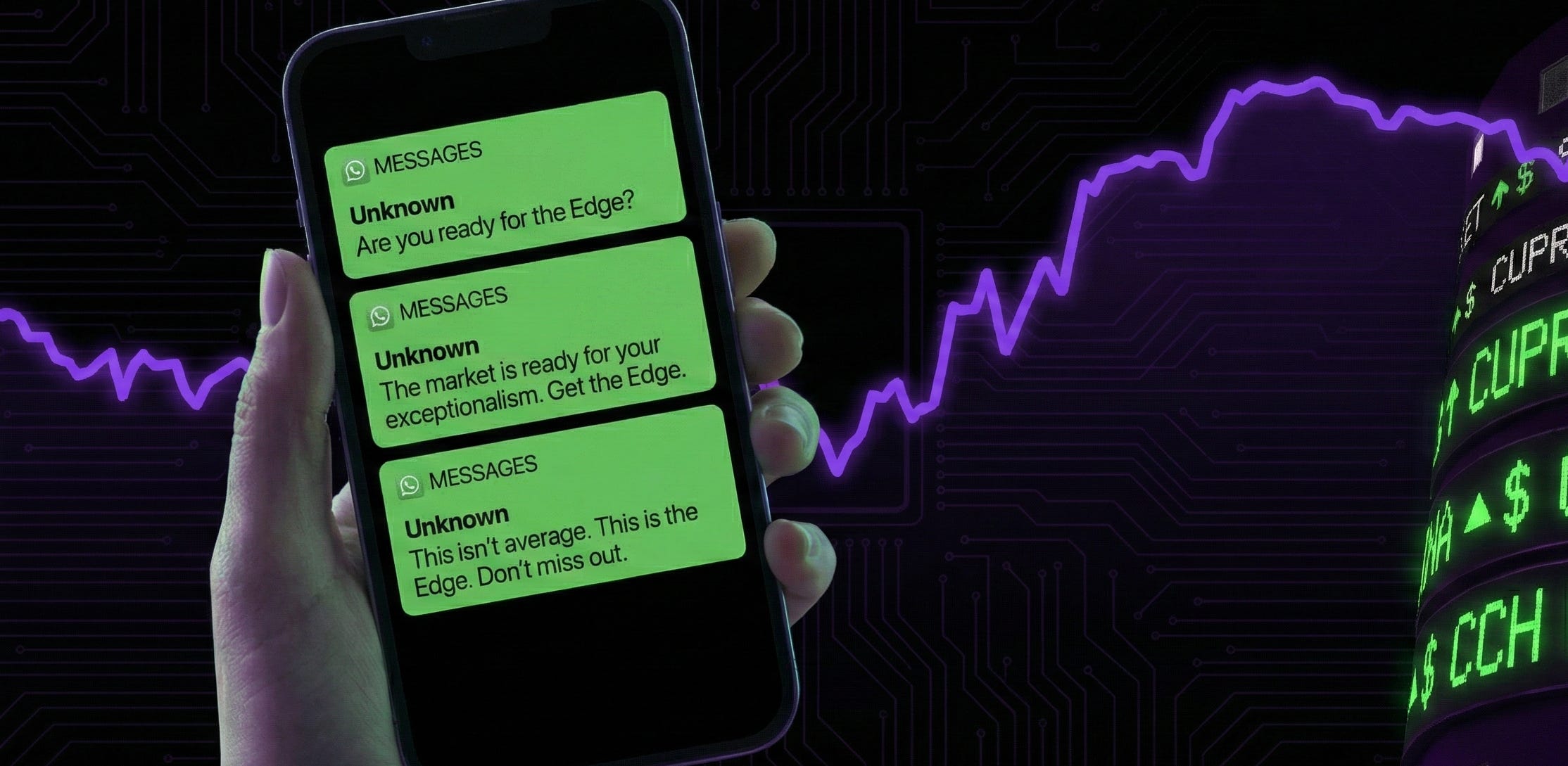
Nobody comes to the stock market to be average. They come to beat it. And to beat it, investors are always searching for an Edge.
Which is why, if you want to commit crimes against investors, the first thing you do is sell them an Edge. You can’t promise “market returns” because market returns are boring and available to everyone for free. Scammers have to sell the idea that the rules apply to everyone else, but not to you.
If you’re buying a sketchy token called “SuperMoonRocket,” you understand—or should understand—that you’re in the Wild West. Losing everything is a real possibility.
Scammers know this. So their problem is not the scam, it’s the venue. To really sell the scam, you need a place that implies safety. You need a boutique. You need the NASDAQ.
A Short Theory on Expensive Signals
If you buy a watch at a certified Rolex boutique, you pay a bit extra. You are not just paying for the watch. You are paying for the assurance that the watch is real. The boutique has high rent and fancy lighting and staff who judge your shoes. All of this is an expensive signal that they are not going to sell you a fake watch.
The stock market is supposed to be that boutique. Specifically, the NASDAQ is supposed to be a very nice boutique.
When a company lists on the NASDAQ, the market assumes that because the company went through the NASDAQ listing process, sent paperwork to the SEC, and hired an underwriter, it likely (1) exists, (2) has real money, and (3) is not a fraud.
The most efficient scam, then, is to rent the NASDAQ’s reputation so your fake feels real.
The Modern Pump-and-Dump
The classic “pump-and-dump” has migrated from the penny stock back alleys to the NASDAQ. The playbook is simple. Scammers take a tiny, often foreign-based company, find a small US underwriter willing to take it public. They list it. And once it has that magical ticker symbol, they unleash the promotions.
But, instead of getting old school cold calls from a boiler room, you get added to a WhatsApp group.
The scammers send out innocuous and generic investing wisdom full of profound Warren Buffet quotes, building trust over time. Eventually, they drop the pitch: “Are you ready for the Edge?”
The companies they do this with are delightful:
Cuprina Holdings: A Singaporean firm with $76,000 in revenue that treats chronic wounds using medical leeches and maggots.
Charming Medical: A Hong Kong company specializing in “womb warming and pelvic detoxes.”
CCH Holdings: A Malaysian chain of chicken claypot restaurants.
I want to be clear that I am not an expert in the valuation of medical leeches. Perhaps “womb warming” is the next AI? Either way, CCH Holdings was valued at $5 million and briefly hit a $300 million valuation during a WhatsApp promotion before collapsing more than 80% the next day. Charming Medical surged from $4 to $29, then crashed.
The Psychology of the Edge
These companies are not the next Google. But they don’t have to be. They just need to be on the NASDAQ, which signals: “It’s okay, the adults have checked the paperwork.”
The "adults," however, have an incentive problem. NASDAQ collects listing fees. The underwriter can earn hundreds of thousands of dollars to conduct "due diligence," which in this world means "checking that the staples are in the correct corner and that the fee has cleared."
These works because the stock is real. You can look these companies up on your phone and trade them how you trade everything else. No back alley.
In the last two years, about $16 billion has vaporized in these schemes. The SEC is suspending stocks, FINRA is investigating underwriters, and NASDAQ wants them out. But enforcement is hard. The scammers are anonymous and overseas, the companies move jurisdictions, and the money is moved before anyone notices.
The scam isn’t that these companies are hiding their secrets. The filings you will definitely not read are right there! The companies will tell you that they have zero revenue, a questionable relationship with a maggot farm, and a high probability of going to zero.
None of that matters. The scammers are betting on two pillars of human nature that have worked for the last 100 years:
Your trust in "The System" is stronger than your ability to read a balance sheet. The scam is the realization that regulators don't actually stop companies from being a disaster; they just require them to disclose that they are a disaster.
Your desire to be “in on it” overrides the part of your brain that knows chicken-pot restaurants shouldn't be worth $300 million.
The Edge is not informational or financial; it’s emotional. You are not buying a stock. You are buying the brief, intoxicating belief that the market has finally made room for your exceptionalism.