
Here’s a strange sentence:
A warehouse worker kicked a bag labelled “millions of dollars of nickel” and discovered it was full of rocks. This briefly became one of the most important events in the metals market.
To understand why, you first need to understand how futures actually work.
A futures contract is a simple promise wrapped in extremely complicated plumbing.
It says:
“On a certain date in the future, I will buy or sell a specific thing at a price we agree on right now.”
The thing is usually a commodity: oil, nickel, gold, corn, wheat etc...
Commodities are fungible: one tonne of nickel is the same as any other. One barrel of oil is the same as the next. Nobody cares whose it is.
This boring-sounding concept quietly stabilizes fuel prices, food prices, and whether actual companies survive.
Two kinds of people trade futures:
Hedgers:
Real businesses trying not to go bankrupt by surprise. Airlines lock in fuel costs. Farmers lock in crop prices. They want peace.
Speculators:
People who don’t need the thing, but would like to turn their opinions into money.
Commodities Never Leave the Basement
There are giant vaults underground stuffed with commodities.
Take nickel, for example. Not theoretical nickel.
Real, heavy, miserable nickel.
If you buy nickel futures, you don’t immediately get a box of nickel at your door.
You receive a contract that gives you a fancy legal right to request physical delivery of nickel at a later date.
Almost nobody does.
Instead, people just trade database entries that represent the promise. People don’t trade the thing—they trade the price. Any profit or loss just shows up as numbers in an account, not a truck in your driveway.
So, the nickel stays exactly where it is:
In the dark.
Underground.
It does not move through the system.
The system moves around it.
Its job is not to be used.
Its job is to sit still while people argue about its price.
The Warehouses That Make Everyone Feel Better
There are warehouses around the world approved by the London Metal Exchange (LME). These warehouses store real, physical metals—nickel, copper, gold—which backstop futures contracts.
These metals don’t move much. They sit there so that when someone trades a futures contract, there is something tangible behind it.
JPMorgan had ownership over some nickel stored in one of these LME-approved warehouses. This nickel supported real trades. Real risk. Huge positions.
Very nice. Very cool.
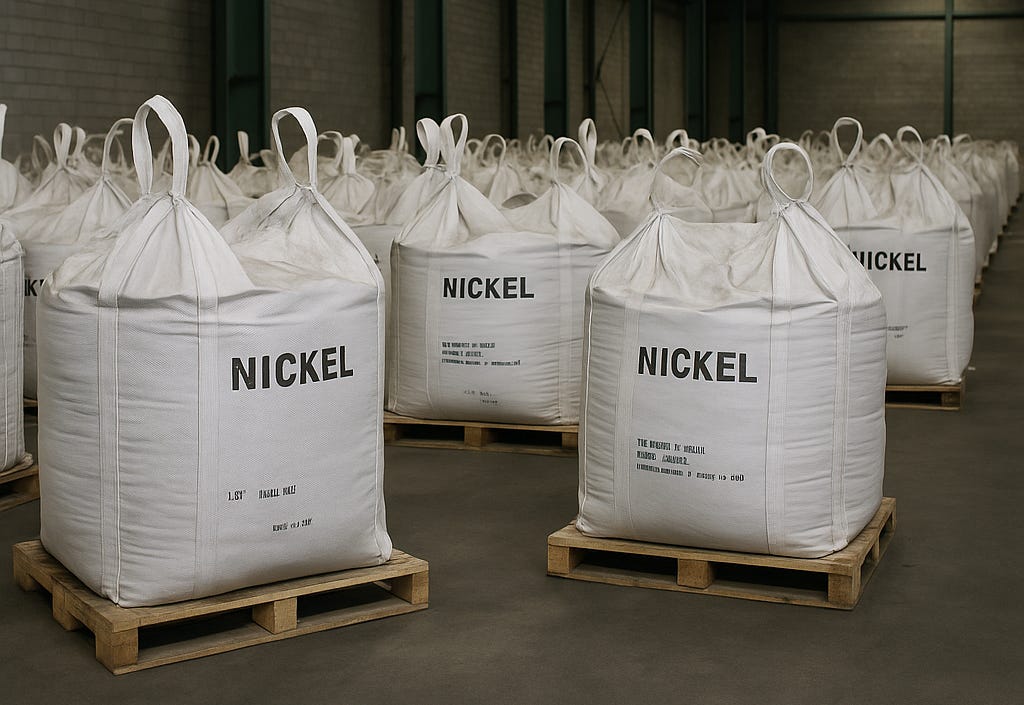
Then One Bag Got Kicked
At some point, workers at a warehouse in Rotterdam were doing a routine check.
Someone physically kicked a large bag labelled something like: $2 million worth of nickel.
They noticed its sound wasn’t right. Instead of feeling like solid, dense nickel, it felt… wrong.
Inside the bags? Rocks.
Investigators believe one of two things happened:
Theory 1: They were always rocks.
Someone delivered bags of stones into the warehouse instead of nickel, and nobody noticed for years.
Theory 2: Someone swapped them.
The bags originally contained real nickel, and someone later broke in, stole the metal, and replaced it with rocks.
High Finance, Low-Tech
This is kind of funny. Not because money was lost.
But because of the contrast.
On paper, the global commodities system is incredibly sophisticated. Elaborate systems model supply, demand, weather patterns, shipping bottlenecks and geopolitical risk.
And then there are….bags in a warehouse.
And the weakest link in the chain wasn’t a global market event; it was that nobody kicked the bag earlier.
The Actual Point
Despite how ridiculous this all sounds, commodity futures are a quiet miracle of modern finance.
They let farmers survive weather, airlines survive oil prices, and speculators survive boredom. And they keep global supply chains functioning.
But every once in a while, someone should probably go downstairs and check the bags. Because sometimes the market needs sophisticated computer models, and other times it needs a kick.