
One of the great enduring fantasies of financial markets is that somewhere, somehow, Someone™ knows something you don’t. And if you could only find this information, you could make lots of money on the stock market.
And the fantasy is very important, because without it you are just a normal person buying ETFs and replying ‘sounds good!’ to emails that do not, in fact, sound good.
And so people keep trying to find that fantasy. Usually, that means scrolling the internet to find other people’s guesses about other people’s guesses, and buying stocks based on that.
Sometimes it works and you feel like a professional trader for a day. Often it does not, and you lose a little money. But the fantasy survives, because the fantasy is more fun than the math.
Most of the market is just people guessing and calling it strategy. But occasionally the market produces trades that are so specific, so timed, and so concentrated that they don’t feel like people chasing a fantasy. This is where watching weird options trades starts getting interesting.
First, a short lesson on what options are.
Options: Using Taylor Swift Instead of Math
Think of a stock like a Taylor Swift ticket. You can buy it. You can sell it. It just sits there being a thing you own.
An option is not the ticket. An option is a digital contract that says, “Later, if you feel like it, you can buy this ticket for a price we agree on now.” You are not committing to buying the ticket (yet). You are committing to the right to decide whether you want to later on.
So, suppose tickets are $100 today. You think they might be $200 later, because everything involving Taylor Swift eventually becomes chaos. But you also think she might add more shows and prices might fall and then you will feel extremely silly paying $100 for something everyone else is buying for $60.
Instead of buying the ticket, you pay someone $10 for the option to buy it for $100 anytime this month. They are thrilled. If you don’t want the ticket, they keep the $10. If you buy, they get $100 plus your $10 fee.
You are also thrilled, because now you get to wait and see. If tickets go to $200, great, you buy for $100, sell for $200, and your $10 gamble turns into profit. If prices drop, you shrug, don’t buy the ticket, and you are only out the $10.
Three Mostly Legal Reasons People Trade Options
Options exist because the future is annoying and people would like to have opinions about it without putting all their money behind those opinions.
Broadly, there are three types of people who trade options:
Maybe you are an airline or a pension fund or a very serious institution with a spreadsheet and you own a lot of stock. You buy options as insurance so one bad headline does not ruin your whole month. This is not sexy, but it is how you stay in business.
Retail traders like options because they are cheap in a very psychologically dangerous way: instead of needing thousands of dollars to buy stock, you can spend a few hundred dollars for a chance at a very large payoff.
And then there are people who actually do know what will happen to a stock very soon, in the extremely illegal sense. Options are great for that, because they turn inside information into profits with very little upfront cash.
Which is why, when you see a big options trade appear out of nowhere, it’s worth looking at.
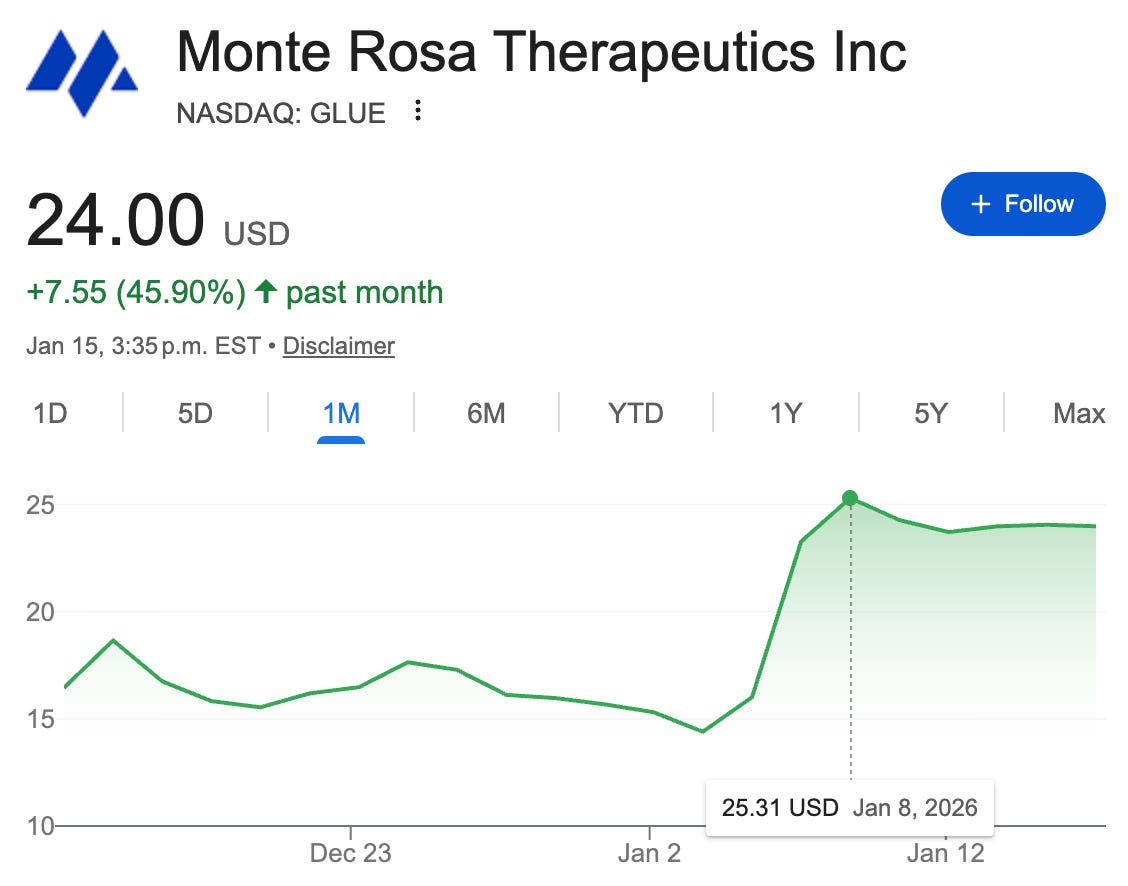
Minutes before the market closed on January 6, someone made a very confident bet on Monte Rosa Therapeutics, a small biotech company that you have definitely never heard of.
They spent about $200,000 on options that expired in 11 days, which is not a “long-term believer in science” trade so much as a “something is happening ASAP” trade.
This was several times more activity than the stock usually sees, all piled in at once, right before the bell, near when the company said it was about to release drug trial results. Which is, as coincidences go, extremely convenient.
Hours later, the company reported positive data showing its inflammation-targeting drug candidate produced strong early results. The next morning, the stock jumped 45%.
And that $200,000 bet very quickly turned into over a million dollars, overnight. The kind of fantasy return that makes people briefly believe in destiny, manifestation, and possibly scoring an Eras Tour ticket.
When Guessing Starts Looking Like Knowing
Now, does this prove someone committed extremely ambitious and maybe obvious securities fraud? No. Markets are weird, and sometimes people guess right in extremely dramatic fashion.
Most of the time, there is no Someone™. There are just a lot of people buying Taylor Swift tickets and hoping resale prices go up.
But every now and then, Someone™ buys a very specific ticket to a very specific show right before the curtain goes up.
And that is when the whole fantasy stops being cute and starts being useful. Because instead of chasing rumours, you can just look at the trades themselves.
Options data is public. And because of that, the market is occasionally telling you exactly where the loudest, most confident bets are being placed. Next time, instead of doomscrolling Twitter or watching some analyst on TV, pay attention to the easily overlooked options trade that could actually mean something.
You probably won't ever meet that Someone™. But you do not actually need to find them. You just need to notice when someone suddenly bought front-row Taylor Swift tickets before Ticketmaster even listed the tickets.