
The way capitalism works is that if you invent a life changing AI tool that has ingested the entirety of human knowledge and can answer almost every question known to man, a reasonable first thought is, "This will elevate humanity". A second thought, of course, is: "Let's put a Geico ad in this thing."
OpenAI recently sent an email to its users saying it’s adding ads. Rude, but inevitable.
This follows the classic lifecycle of a pre-IPO technology company.
You invent a magic trick. You build software that does some witchcraft, like summoning a car from your phone or a god-like AI that allows you to cheat on your homework. You give it to people. People are amazed.
You realize that operating this magic trick is very expensive. Computers cost money. So you raise billions of dollars from venture capitalists.
The venture capitalists, having given you billions of dollars, would respectfully like tens of billions of dollars back.
And eventually, the everyone with a stake in the company thinks “I want billions of dollars too.”
So, you go public.
I don’t know, that’s kind of the point of the stock market? It’s a machine for turning weird startup magic into financial products. Going public allows the founders and venture capitalists to get mega rich right now. It gives you a chance to get slightly rich over the next 30 years. It gives CNBC anchors something to talk about. It gives me a reason to have a mediocre Substack.
This is mostly…great? It means: 1) regular people can put a piece of the future in their investment accounts, and 2) it incentivizes stressed-out engineers to live in a basement for five years trying to invent a a robot that can play chess.
But going public also means that the god machine is not judged by whether it elevated humanity, but whether it beat quarterly earnings estimates by two cents a share.
When you are a private company, your only job is to make your users so happy they tell their friends. Your product is optimized for joy. But when you are a public company, your user morphs into a fund manager who wants to see 15% year-over-year revenue growth.
And so, you stop optimizing for the best product, and you start optimizing for the most monetizable product.
You start adding tabs to the app. You start sending push notifications. And, inevitably, inescapably, as sure as water flows to the sea, you start selling ads.
Which brings us to OpenAI.
OpenAI is not technically a normal company [1]. It has raised roughly the GDP of a medium-sized European nation. They started as a non-profit. Then they realized that making a god machine required a lot of computer chips, which cost money, so they became a for-profit company. Then they realized they needed more money, so they became... whatever they are now.
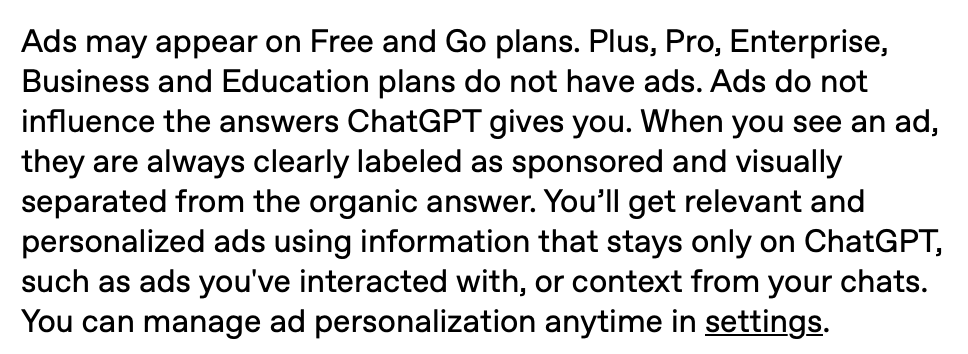
OpenAI recently sent users an email a masterpiece of corporate reassurance. It says:
“Ads may appear on Free and Go plans... Ads do not influence the answers ChatGPT gives you. When you see an ad, they are always clearly labeled as sponsored and visually separated from the organic answer.”
I mean, sure? But tech companies have spent twenty years swearing that their ads are just innocent algorithms serving relevant content, and not at all based on spying on you. Which is a comforting thought, except for the reality that if you tell your neighbour your back hurts, your phone will immediately show you a pop-up ad for a chiropractor.
OpenAI is making the same promise. The ads do not influence the answers! You ask your AI, “What is the meaning of life?” and, after consulting the entire wisdom of human history, it replies:
Have you considered consolidating your high-interest credit card debt with a personal loan from BigBank? Click here to learn more!
I guess this is OpenAI telling us they cannot charge a monthly $20 subscription fee forever. Eventually, you have to tap into the great, gushing geyser of internet money, which is advertising.
It is a tragedy, but it is a very efficient tragedy.
Alas, this is the grand bargain of capitalism. You need hundreds of billions of dollars to build a machine that can cure diseases. But the price of raising those hundreds of billions of dollars is that, sooner or later, the machine is going to figure out how to squeeze a sponsored link for a new mattress into a conversation about philosophy.