
For a long time, the theory of investing was “buy what you know.” You’d go to the mall, notice a massive line at the pretzel stand, and think, "Ah, people are buying pretzels, I should buy their stock." Or, your neighbour would say they were working him to the bone at the widget factory, and you’d think, bullish for widgets, and buy widget stock. It was a simpler time. You were doing research, but, mostly by accident.
Then the finance industry arrived with mutual funds. This was basically a guy in a nice suit saying, “I am much smarter than you. Give me your money, and I’ll pick stocks better than you can, for a 2% fee.” And for a while, people were like, sure, because suits were expensive and their office had frosted glass.
But, through time, people started realizing that the mutual fund guy was basically just buying a handful of well known top stocks, but charging you 2% for the privilege. To solve this, ETFs (which did the same thing for less fees) were invented and trillions of dollars fled to them. This undercut the value of paying a guy in a suit to guess which stocks would go up. Rude!
Over time, buying and holding ETFs became deeply boring for the modern investor. Your portfolio crept up in a slow, responsible way with nothing exciting ever happening. No drama. No story. No “I knew it.” Just… slow compounding.
Buying an ETF and not looking at it for thirty years was the mathematically correct way to live your life, but it denied people a core psychological need: the deep, burning desire to feel something. The thrill of knowing a secret. The rush of being the person who “saw it coming.” The smug little warmth of thinking, “I know a guy at the widget factory.”
Alas, around 2020, we entered the era of hyper-empowered self-directed trading: zero-commission apps, confetti animations, Twitter, and a firehose of professional-grade market data that made normal people think, “Why would I pay an expert when I can do this myself?” Investors started to realize they could find the secrets themselves.
The Bots Are Here
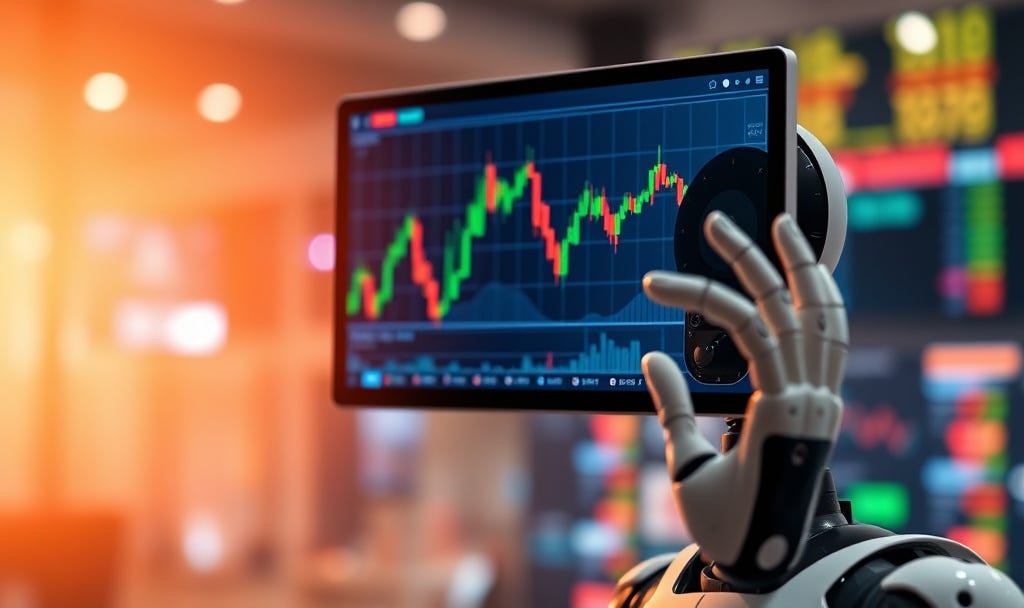
And that carries on to today, but now we’re seeing the start of the next shift: AI-enabled trading.
Academics recently1 fed 33 years of trading data into AI, and it successfully predicted 71% of human portfolio managers’ trades.
This is kind of..offensive? Imagine finding out your well-researched trade ideas backed by years of education are now largely replicated by a free ChatGPT subscription.
This is pointing to what will happen in the very near future. Soon, you’ll open a chat window and say,
“I want to take on a terrifying amount of risk to capture a tiny profit, please trade for me.”
And the AI will do it. Instantly. Cheaply. Possibly for free.
This will result in a market made of millions of AI robots instantly pricing in everything: earnings, rate hikes, geopolitics, weather, politics. If an earthquake hits Chile, four milliseconds later a million AI models will quietly adjust the price of copper by exactly $0.0143.
The market will become flawlessly efficient. Probably too efficient.
But the academics noted a funny twist. What about the 29% of trades the AI couldn’t predict? Those were the ones that actually generated the outperformance. The edge on these? It wasn’t in the math, it was the mysterious edge of a human having a “weird feeling” and trading entirely on a hunch.
So, if machines are perfectly optimizing the math, maybe the only remaining edge is doing something that makes absolutely no mathematical sense: driving out to the local shopping mall, looking around to see which stores are busy, noticing a massive line at the pretzel stand, and thinking, “Ah, people are buying pretzels.”
Lauren Cohen & Yiwen Lu & Quoc H. Nguyen, 2026. “Mimicking Finance,” NBER Working Papers 34849, National Bureau of Economic Research, Inc.