
There is a very simple story about money. It begins with the observation that your $5,0001 is adorable.
It’s great. It’s earnest. It is working hard. But it cannot do much.
It cannot buy a warehouse, or a copper mine, or an early-stage startup. It also cannot hire a brilliant financial analyst who lists ‘machine learning’ as a hobby.
Most importantly: your $5,000 does not unlock any of the secret doors in finance.
And so a workaround was invented:
What if we smushed a bunch of these tiny $5,000s together?
What if we created one giant blob of money, and then put someone in charge of deploying it in ways none of the individual $5,000s ever could?
That is a fund.
Why Funds Exist (The Nice Version)
A fund gathers pockets of money from lots of people and puts them into bigger, better, more powerful opportunities. Investors get scale, buying power, access, and diversification. The fund gets some fees and the occasional Forbes article.
If you’re a normal person, you do not have the resources, time, or professional-grade boredom tolerance required to read through 400 pages of bond covenants. A fund does that for you.
This is the polite version.
Why Funds Exist (The Real Version)
The real version is:
“Look, we are smarter than you.”
That is the unsaid pitch of every fund.
They hire very smart people, put them in glass-and-steel offices, feed them kombucha, and ask them to find the tiny cracks in the financial universe where money leaks out.
You, meanwhile, are at home Googling “what to watch tonight.”
And that’s fine!
Because the entire financial system rests on a polite handshake: You give us money; we make more money than you can on your own.
The Boredom Problem
Here’s the issue:
Humans are not very rational.
We like returns.
But we love stories.
A boring, reliable 5% compounding stock?
Beautiful. Sensible. Diligent.
Also: deeply unsexy.
Most people like predictable returns.
But they crave returns with adventure attached.
Humans want new, because “new” feels like edge.
So an entire universe of alternative investments has emerged:
Private credit, rare wine, farmland, baseball cards, cat bonds, crypto .jpgs. Basically anything that is shiny, scarce, and narratively satisfying.
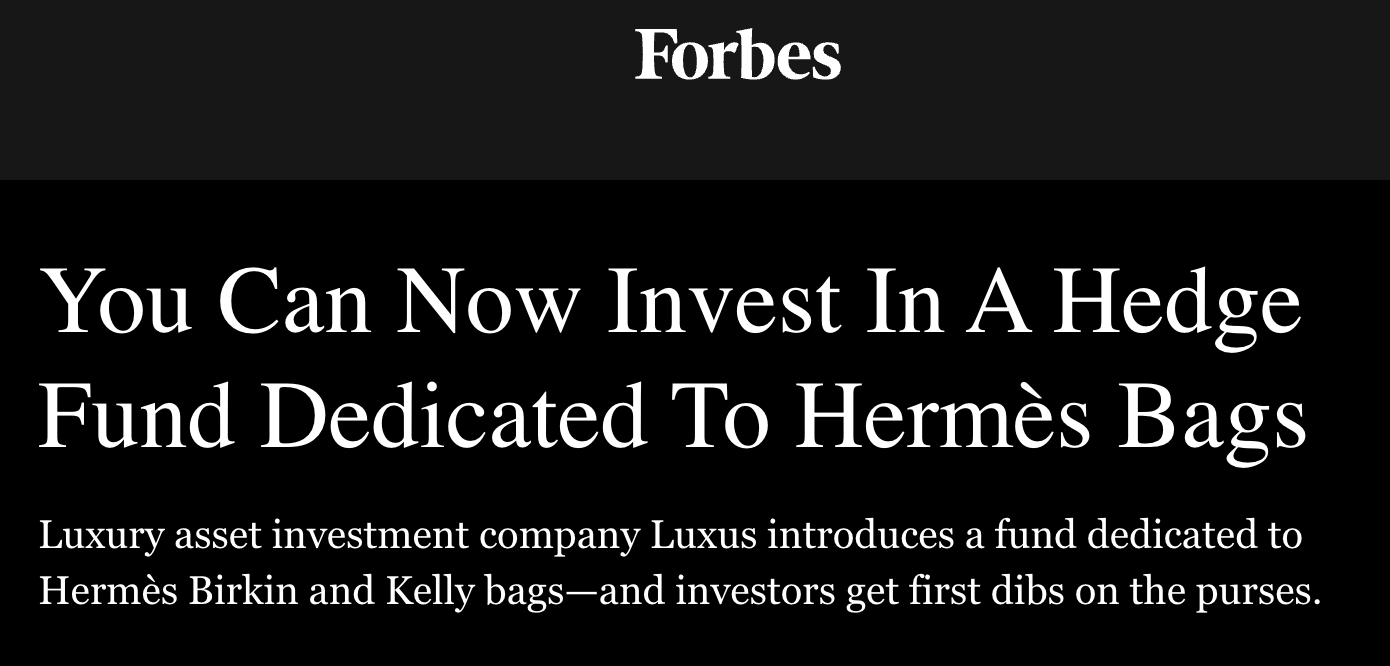
Enter, Hermès Bags
And so, naturally, we arrive at the most logical outcome of this psychology:
A hedge fund dedicated entirely to Hermès Birkin bags.
Seriously, it’s real. And it’s backed by Christie’s and run by an ex-Blackstone executive.
The first fund raised about $1 million, bought and sold some Birkins, and reported strong returns. Demand was high enough that they launched a second fund.
Of course someone did this.
How the Hermès Fund Works
Investors put money in. The fund takes that money and buys scarce, authenticated Birkin bags from the secondary market.
The bags get inspected, tagged, wrapped back up, and placed in a vault like tiny leather treasure bars. They don’t get worn or shown off.
The logic is straightforward: not many Birkins exist. The fund buys from people doing spring cleaning and sells to people doing emotional spending.
While one person needs money, another needs a Birkin.
The Real Lesson
If you wonder why a Birkin hedge fund exists, it’s simple: traditional assets get boring, and finance hates being bored.
Every few years, finance picks a new Thing™ and decides it’s investable.
Tulips.
Railroads.
Baseball cards.
Crypto kittens.
Now: Hermès bags.
It’s not absurd. It’s inevitable.
So yes, a Birkin hedge fund exists because finance hates boredom. But the deeper truth is that investors hate feeling ordinary.
Behind it is the same human impulse that has driven every bubble, boom, and bizarre investment fad for 400 years: the desire to believe you’ve found something special.
Investors don’t want merely to make money; they want to feel like they’ve discovered a secret door.
To be clear, funds probably won’t take your actual $5,000. I picked it because “your $750,000 cheque is adorable” hits a little differently.